
Biblical Foods & Recipes: What Scripture Can Teach Us About Eating Well Today
Food is woven throughout the story of Scripture.
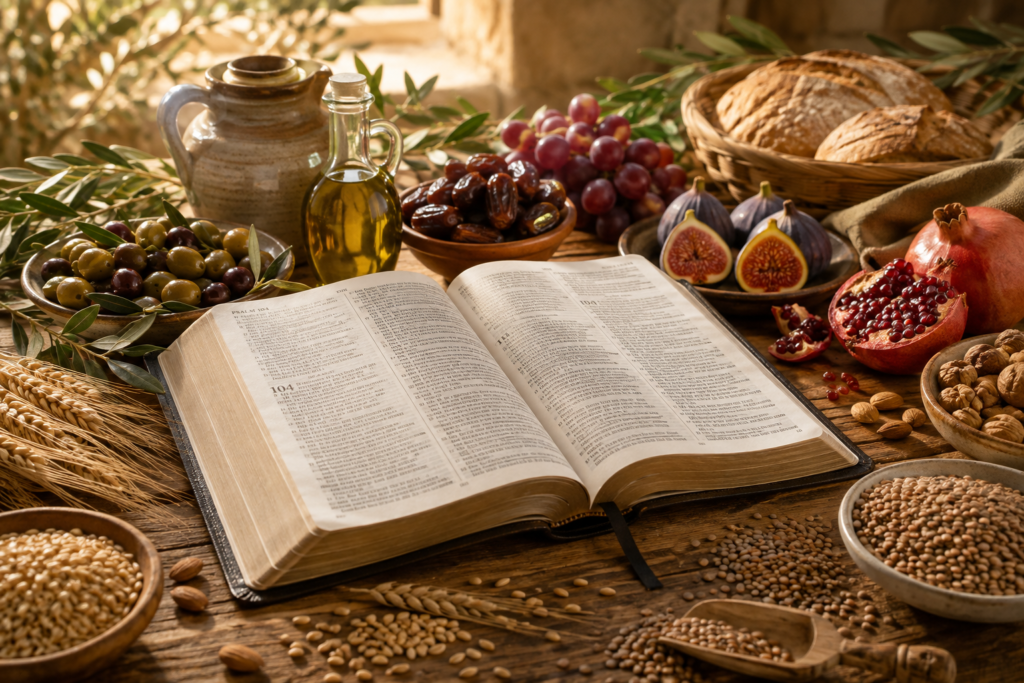
We find wheat and barley growing in fields, olives being pressed for oil, grapes hanging from vines, figs and pomegranates gathered from trees, lentils simmering in a pot, fish being pulled from the water, bread being broken around tables, and meals being shared among families, friends, strangers, and communities.
These foods were part of ordinary life in the biblical world.
But what, if anything, can they teach us about eating well today?
At Holistic Shalom, we don’t believe the Bible gives us a secret diet or a collection of foods with miraculous healing powers.
Nor should we assume that a food is healthy simply because it appears somewhere in Scripture.
Instead, we see something much richer.
God has provided food to nourish us. Scripture can help us appreciate that provision. Science can help us understand it. And wisdom can help us put it on our table.
A Land of Abundance
One of the most beautiful biblical descriptions of food appears as the Israelites prepare to enter the land God had promised them.
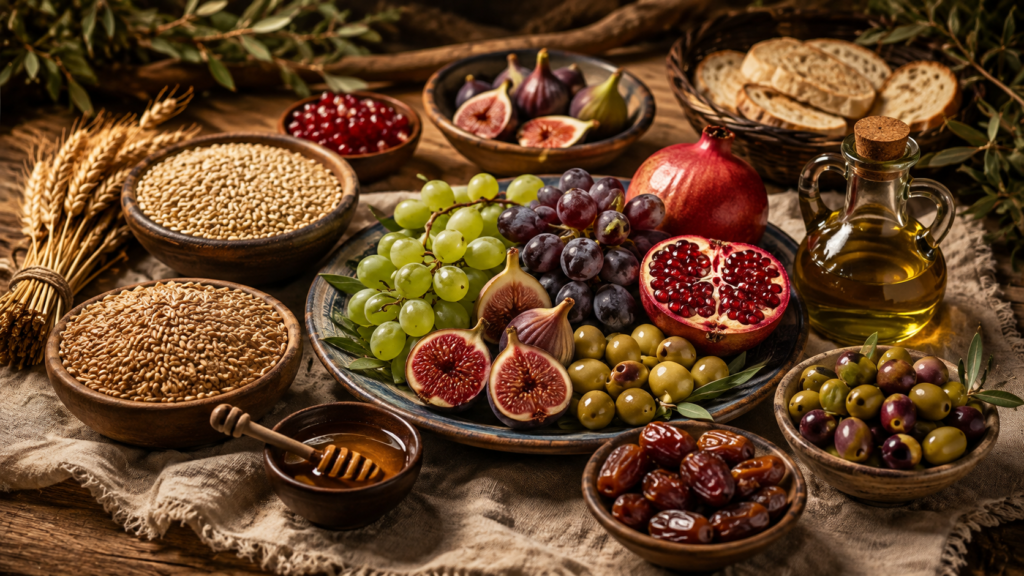
“a land with wheat and barley, vines and fig trees, pomegranates, olive oil and honey”
— Deuteronomy 8:8
The surrounding passage is not presenting a nutrition plan.
It is describing God’s provision.
The Israelites were being brought into a good land with water, agriculture, food, and resources—a place where they could eat and be satisfied.
And immediately afterward comes an important instruction:
“When you have eaten and are satisfied, praise the LORD your God for the good land he has given you.”
— Deuteronomy 8:10
That helps us understand the list.
Wheat, barley, grapes, figs, pomegranates, olives, and honey are not presented as mystical health foods.
They are part of a larger picture of provision, nourishment, abundance, and gratitude.
And the appropriate response to abundance is not obsession.
It is gratitude.
The Seven Foods of Deuteronomy
Over time, the foods of Deuteronomy 8:8 became known in Jewish tradition as the Seven Species associated with the land of Israel.
They are traditionally understood as:
- Wheat
- Barley
- Grapes
- Figs
- Pomegranates
- Olives
- Dates
The final item deserves some explanation.
Many English translations simply say “honey.”
Many Jewish interpreters and scholars understand the “honey” in this particular agricultural list as date honey—a sweet syrup made from dates.
Other biblical passages clearly refer to bee honey, so the meaning depends upon context.
That small example demonstrates something important about how we will approach this entire series.
We will seek to:
Read Scripture carefully.
Understand the historical food.
Examine the science honestly.
Apply wisdom.
Then bring what we have learned into our kitchens today.
Is There Really a “Biblical Diet”?
Probably not in the way modern diet culture uses the term.
You can find books, videos, and programs promising that a particular “Bible diet” will reverse disease, produce rapid weight loss, or unlock extraordinary health.
We should be cautious whenever Scripture is used to make promises Scripture itself does not make.
The Bible was not written as a modern nutritional science textbook.
It does not teach that eating figs will cure disease.
It does not say olive oil will prevent a heart attack.
It does not tell us that pomegranates detoxify the body.
And mentioning honey in the Promised Land certainly doesn’t mean unlimited amounts of honey are healthy.
Making those claims would ask Scripture to say things it never says.
But there is another mistake we should avoid.
We shouldn’t assume that because the Bible isn’t a nutrition textbook, it has nothing meaningful to teach us about food.
Throughout Scripture, food exists within a much larger picture:
Provision.
Gratitude.
Stewardship.
Hospitality.
Celebration.
Community.
Wisdom.
Dependence upon God.
Those principles remain deeply relevant.
Scripture and Science Ask Different Questions
This distinction is foundational to Biblical Foods & Recipes.
When Scripture mentions olive oil, our first question should be:
What is happening in this biblical passage?
When nutritional science investigates olive oil, the question becomes something different:
What happens physiologically when people consume different kinds and quantities of olive oil as part of their diet?
Those are different questions.
They don’t need to compete with one another.
Nor do we need to manipulate one to prove the other.
Modern research has found that dietary patterns emphasizing foods such as vegetables, fruits, legumes, nuts, whole grains, fish, and extra-virgin olive oil can support health.
That doesn’t prove that God encoded a modern Mediterranean diet into Deuteronomy.
It simply means that many traditional whole foods familiar to the biblical world remain nutritionally valuable foods today.
And that is worth exploring.
Seven Foods From the Biblical Table
Let’s look more closely at the foods of Deuteronomy 8:8—not as miracle foods, but as foods worth understanding.
For each one, we’ll ask four questions:
- What did it mean in the biblical world?
- What does modern nutrition tell us?
- What should we avoid exaggerating?
- How might we use it wisely today?
1. Wheat
Wheat was an important grain in the biblical world and is the first food named in Deuteronomy 8:8.
Grain could be ground into flour and transformed into one of humanity’s oldest staple foods:
bread.
But saying “people in the Bible ate wheat” doesn’t answer one of the most important questions for us today:
What kind of wheat food are we eating?
A grain can be eaten relatively intact.
It can be milled into whole-grain flour.
Its bran and germ can be removed to produce refined flour.
That refined flour can then be used in foods whose nutritional characteristics vary considerably depending upon their fiber content, added sugars, fats, portion size, and overall degree of processing.
Those aren’t nutritionally identical foods simply because they all originated as wheat.
Modern research gives us good reason to favor fiber-rich whole grains as part of an overall healthy eating pattern.
This gives us an important Holistic Shalom principle:
Biblical food names are the beginning of the conversation—not the end.
From Scripture to Your Table
Choose breads and grain foods that preserve more of the original grain rather than assuming every product labeled “wheat” is equivalent.
What Is Healthy Bread?
Whole grains, refined flour, ingredient labels, processing, and how to choose bread wisely.
2. Barley
Barley appears alongside wheat in Deuteronomy and repeatedly throughout Scripture.
It was an important agricultural crop and everyday food.
It also appears in one of the New Testament’s best-known meals.
In John 6, a boy has five barley loaves and two fish before Jesus feeds the multitude.
The theological significance of that story is obviously far greater than the nutritional properties of barley.
But the passage also gives us another glimpse of an ordinary grain that people actually ate.
Today barley offers something many modern diets could benefit from:
a minimally processed whole grain containing substantial dietary fiber.
Instead of thinking only about flour-based grain products, barley invites us to rediscover grains that can be eaten much closer to their whole form.
From Scripture to Your Table
Barley can become the foundation of a meal rather than merely an ingredient in bread.
Holistic Shalom recipe idea:
Barley, Pomegranate & Herb Bowl
Whole barley, vegetables, fresh herbs, pomegranate, nuts, and an extra-virgin olive-oil dressing.
3. Grapes
Vines are repeatedly associated with agriculture, provision, and abundance throughout Scripture.
When the Israelite spies explored the land in Numbers 13, they returned carrying grapes along with pomegranates and figs.
Grapes could be consumed fresh, dried into raisins, or processed in other ways.
And this introduces an important modern nutrition lesson:
The same food can affect what and how much we consume depending upon how it has been processed or concentrated.
Whole grapes provide water, natural sugars, fiber, and numerous plant compounds within the structure of the fruit.
Juicing removes much of that structure and makes it considerably easier to consume the sugars from many grapes very quickly.
Drying removes much of the water and concentrates both nutrients and natural sugars into a much smaller volume.
None of those foods needs to be called “bad.”
But they are not identical.
Wisdom includes understanding the difference.
From Scripture to Your Table
Enjoy whole grapes as fruit while recognizing how drying, juicing, and concentration change the foods we eat.
4. Figs
Figs appear repeatedly throughout Scripture and were an important fruit of the region.
They could be eaten fresh, while drying allowed fruit to be preserved for later use.
That mattered enormously in a world without modern refrigeration.
Scripture even refers to cakes of pressed figs, giving us a glimpse of how fruit could be preserved and transported.
Figs provide natural sweetness along with fiber and various micronutrients.
But once again, the form matters.
A fresh fig contains considerably more water than dried fruit. Dried figs are therefore more concentrated and easier to consume in larger quantities.
That doesn’t make dried figs unhealthy.
It simply reminds us that whole, natural foods still benefit from wisdom and appropriate portions.
From Scripture to Your Table
Fresh figs pair beautifully with plain yogurt and nuts.
Dried figs can be enjoyed thoughtfully as part of meals or snacks that also provide protein, fiber, or healthy fats.
Holistic Shalom recipe idea:
Fig & Walnut Yogurt Bowl
Plain yogurt, fresh figs, walnuts, and, if desired, a small touch of honey.
5. Pomegranates
Pomegranates appear in both everyday and symbolic settings throughout Scripture.
Numbers 13 records the explorers returning from the land with grapes, pomegranates, and figs.
The fruit later appears symbolically in Israelite worship and decoration as well.
Modern interest in pomegranates often focuses on their polyphenols and other plant compounds.
This is where nutrition communication can easily become exaggerated.
Words such as “antioxidant” and “polyphenol” can quickly be transformed into claims that a food “detoxes,” “cleanses,” or prevents disease.
That isn’t how good nutrition science works.
Foods contain many compounds that interact with complex biological systems.
Rather than turning the pomegranate into another miracle “superfood,” we can appreciate it for what it is:
a nutritious whole fruit that can contribute to a varied, plant-rich eating pattern.
From Scripture to Your Table
Add fresh pomegranate arils to salads, plain yogurt, whole-grain bowls, or vegetables.
6. Olives & Olive Oil
Few foods connect the biblical world with modern nutrition as naturally as the olive.
Olive trees and olive oil appear throughout Scripture.
Olive oil was far more than a cooking ingredient. It played roles in food, lighting, commerce, hospitality, and religious life.
Today olive oil is also one of the most extensively researched traditional dietary fats.
Large randomized dietary research has found cardiovascular benefits from a Mediterranean dietary pattern that included substantial extra-virgin olive oil.
But even here we need an important qualification:
“Olive oil” is not one uniform product.
Extra-virgin olive oil differs from highly refined olive oils in processing and composition.
Quality can also be influenced by harvesting, extraction, age, exposure to light and heat, and storage.
So simply buying a bottle with the words “olive oil” on the label doesn’t finish the conversation.
It begins another one.
From Scripture to Your Table
Good-quality extra-virgin olive oil can serve as one of the principal fats within a whole-food eating pattern.
Use it with vegetables, legumes, whole grains, salads, and fish rather than treating olive oil itself as medicine.
What Makes Olive Oil Healthy?
Extra virgin versus refined olive oil, polyphenols, processing, cooking, storage, and how to choose a good bottle.
7. Dates & “Honey”
The final food of Deuteronomy 8:8 may be the most interesting of all.
Most English translations say honey.
But as we have seen, many Jewish interpreters and scholars associate the honey in this particular agricultural list with dates, specifically the sweet syrup produced from them.
Dates could be eaten as fruit or concentrated into syrup.
This also gives us a valuable modern nutrition lesson:
Natural sweeteners remain sweeteners.
Honey, date syrup, and refined sugar differ in flavor, processing, and some of their minor nutritional components.
But the word natural doesn’t give us permission to consume unlimited quantities.
Modern nutrition guidance recognizes honey and syrups as sources of free sugars.
That does not make sweetness sinful.
Nor does it mean honey cannot be enjoyed.
It means enjoyment and wisdom belong together.
From Scripture to Your Table
Whole dates provide sweetness along with fiber and other nutrients.
Honey or date syrup can be used intentionally in smaller amounts when sweetness complements an otherwise nourishing meal.
Is Honey Healthy?
Biblical honey, bee honey, date syrup, natural sugars, and how much really matters.
What Has Changed Since the Biblical World?
At this point it can be tempting to romanticize the ancient diet.
We shouldn’t.
People in biblical times faced food insecurity, failed harvests, drought, spoilage, limited seasonal availability, and nutritional deficiencies.
Modern agriculture, refrigeration, transportation, food safety, and preservation have provided extraordinary benefits.
Our challenge is different.
Many of us now live in an environment of unprecedented food abundance.
And much of that abundance comes in forms that would have been unimaginable in the biblical world.
Grains can be extensively refined and transformed into an enormous variety of packaged foods.
Fruit can become juices, concentrates, and sweetened drinks.
Traditional meals can be replaced by highly processed convenience foods.
Food can be available every hour of every day without requiring us to harvest, prepare, or even sit down to eat it.
The lesson therefore isn’t:
“Everything ancient was healthy and everything modern is unhealthy.”
The better question is:
What can simpler foods teach us about navigating a complicated modern food environment wisely?
From Individual Foods to a Pattern of Eating
Perhaps the greatest nutritional lesson in this entire discussion is that health doesn’t depend upon finding one perfect food.
Olive oil isn’t magic.
Pomegranates aren’t medicine.
Figs aren’t a detox.
Barley isn’t a cure.
Nutrition works through patterns.
Modern dietary research repeatedly points toward eating patterns emphasizing foods such as vegetables, fruits, legumes, whole grains, nuts, fish, and unsaturated fats such as extra-virgin olive oil.
Those categories sound remarkably familiar after reading through the foods of Scripture.
But we should make the distinction carefully:
We are not saying modern science has proven “the biblical diet.”
There is no single biblical diet being tested in clinical trials.
We are observing that many simple foods found throughout the biblical world remain valuable components of dietary patterns associated with good health today.
Beyond the Seven Species
Deuteronomy gives us a beautiful starting point, but it is certainly not the end of the biblical table.
Throughout this series we will also explore other important foods.
Lentils and Other Legumes
Jacob’s lentil stew gives us one of Scripture’s most memorable food stories.
Legumes also offer an extraordinary modern combination of dietary fiber, plant protein, vitamins, minerals, and other plant compounds.
Lentil & Vegetable Stew
Lentils, vegetables, herbs, and extra-virgin olive oil.
Meat
Meat also has an important—and sometimes misunderstood—place in the biblical story.
The story begins in Genesis 1 with God explicitly giving humanity plants and fruit for food.
After the flood, Genesis 9 expands that permission:
“Everything that lives and moves about will be food for you. Just as I gave you the green plants, I now give you everything.”
— Genesis 9:3
Later, under the covenant given to Israel, Scripture establishes detailed distinctions between animals considered clean and unclean.
In the New Testament, however, something important changes.
The emphasis moves away from dietary restrictions as a marker of God’s people and toward freedom exercised with thanksgiving, conscience, wisdom, and concern for others.
Romans 14 gives us a particularly helpful picture.
Paul describes one person whose faith allows him to eat anything and another who eats only vegetables.
But Paul doesn’t settle the disagreement by giving Christians a new list of foods everyone should eat.
Instead, he changes the focus.
The person who eats is not to look down upon the person who abstains.
The person who abstains is not to judge the person who eats.
Both are called to honor God in their choices.
Elsewhere, Paul writes:
“For everything God created is good, and nothing is to be rejected if it is received with thanksgiving.”
— 1 Timothy 4:4
Taken together, Scripture gives us a fascinating progression:
Creation → Permission → Covenant Distinction → New-Covenant Freedom
But the destination of that progression is especially important.
The focus is no longer on identifying God’s people by adherence to a particular dietary pattern.
Thanksgiving
Receive God’s provision with gratitude.
Conscience
Make choices you can make faithfully before God.
Wisdom
Exercise freedom thoughtfully rather than assuming that everything permissible is necessarily beneficial in unlimited amounts.
Concern for Others
Do not allow food choices to become a reason to judge, divide, or look down upon another person.
That principle matters enormously in today’s nutrition culture.
Food has once again become something around which people can build competing identities:
Vegan.
Vegetarian.
Carnivore.
Keto – Paleo.
Plant-based.
Low-carb
At Holistic Shalom, our purpose is not to decide which dietary label everyone should adopt.
We have no desire to enter a debate over whether a diet containing meat is inherently superior to a vegan diet—or whether any other named diet is the one diet everyone should follow.
Different people have different needs, preferences, cultures, circumstances, and ways of constructing a nourishing diet.
The more useful question is:
Are you giving your body the nourishment and nutritional balance it needs from the foods you have chosen?
The Holistic Shalom Balance Plate™
That is one reason we use the Holistic Shalom Balance Plate™.
Rather than beginning with a dietary label, the Holistic Shalom Balance Plate™ helps us look at the meal itself.
Are we getting an appropriate balance of protein?
Are we eating plenty of vegetables and other nutrient-rich plant foods?
Are we choosing appropriate sources of carbohydrates and fiber?
Are we including healthy sources of fat?
Are we eating foods that nourish us, satisfy us, and support our overall health?
One person may obtain protein from fish, poultry, eggs, or meat.
Another may rely more heavily on lentils, beans, chickpeas, tofu, nuts, seeds, or other plant foods.
The foods on those two plates may look different.
The nutritional goal remains balance.
There can be more than one healthy way to achieve nutritional balance.
This doesn’t mean every food choice is nutritionally identical or that nutrition science has nothing to teach us about particular foods.
It means we don’t need to turn those differences into competing identities.
The question isn’t:
Which diet camp do you belong to?
It is:
Are the foods you have chosen working together to nourish your body well?
That is the approach we will take throughout Biblical Foods & Recipes.
We will examine individual foods honestly.
We will follow the evidence wherever it leads.
We will acknowledge meaningful nutritional differences when they exist.
But we will not use food to create another set of rules by which we judge ourselves or other people.
Instead:
Receive God’s provision with thanksgiving.
Choose with conscience.
Apply wisdom.
Seek nutritional balance.
And extend grace to those whose table looks different from yours.
Coming in this series:
Should We Eat Meat?
What the Bible and Nutrition Science Actually Say
Fish
Fish appear frequently in the New Testament and were deeply connected to life around the Sea of Galilee.
Modern nutrition gives us another perspective through high-quality protein and, depending upon the species, omega-3 fatty acids and important vitamins and minerals.
Galilee-Inspired Grilled Fish
Fish prepared simply with olive oil, lemon, herbs, and vegetables.
Nuts
Almonds and pistachios appear in Genesis and provide another bridge between ancient foods and modern nutrition.
Nuts can provide unsaturated fats, protein, fiber, minerals, and numerous plant compounds.
Milk & Dairy
“Milk and honey” became one of Scripture’s great descriptions of abundance, while milk, curds, and other dairy foods formed part of ancient pastoral life.
This will also give us an opportunity to investigate fermented dairy foods and how modern dairy products differ.
Herbs & Vegetables
Vegetables, herbs, and seasonings also appear throughout biblical food culture and deserve their own exploration.
And eventually, each can lead us into the kitchen.
Biblical Foods in a Modern Kitchen
Biblical Foods & Recipes isn’t intended to turn dinner into an archaeological reenactment.
We don’t know exactly how Jacob seasoned his lentils.
We don’t need to recreate a first-century kitchen to benefit from barley.
And adding olive oil to a modern meal does not automatically make it a “biblical recipe.”
Our recipes will instead be inspired by foods familiar to the biblical world while applying what we know about nutrition today.
The goal is not historical perfection.
It is practical nourishment.
These aren’t miracle meals.
They don’t promise instant healing.
They are something much simpler:
Real food designed to nourish the body and be enjoyed with gratitude.
More Than Nutrients
Modern nutrition often teaches us to see food as numbers.
Calories.
Protein.
Carbohydrates.
Fat.
Fiber.
Vitamins.
Those things matter.
Understanding them helps us make informed choices.
But Scripture continually reminds us that food exists within relationships.
Food is cultivated.
Prepared.
Shared.
Received.
Celebrated.
Offered in hospitality.
Given to those in need.
Enjoyed around tables.
And ultimately received with thanksgiving.
Perhaps one of the healthiest things we can recover from the biblical table isn’t a particular nutrient at all.
Perhaps it is a healthier relationship with food.
One characterized less by fear and obsession and more by wisdom, gratitude, nourishment, and fellowship.
Beyond the Biblical Table
Food is only one part of the extraordinary natural world we encounter throughout Scripture.
The Bible also introduces us to herbs, spices, aromatic plants, oils, and resins—including substances such as frankincense and myrrh—that played important roles in worship, daily life, trade, and traditional practices in the ancient world.
What does Scripture actually say about it?
How was it used in the biblical world?
What has modern science discovered about it?
And what can we responsibly say about its use today?
Some ancient uses may be supported by modern evidence.
Others may remain uncertain.
And the fact that something is natural or mentioned in Scripture does not automatically make every modern health claim about it true.
Our purpose will not be to turn God’s creation into a collection of miracle remedies.
It will be to explore it with gratitude, curiosity, scientific honesty, and wisdom.
An Invitation Back to the Table
Biblical Foods & Recipes isn’t an attempt to take us backward several thousand years.
Our world has changed.
Our kitchens have changed.
Our food supply has changed.
And nutritional science has given us knowledge the people of the biblical world did not have.
But some things have not changed.
Our bodies still need nourishment.
Food remains one of God’s provisions.
Wisdom still matters.
Gratitude still matters.
Sharing meals still matters.
And simple foods can still nourish us remarkably well.
So as we explore wheat, barley, olives, figs, pomegranates, dates, lentils, meat, fish, nuts, and many other foods throughout this series, we will follow a simple framework:
Scripture
What does the Bible actually say?
History
What can we reliably know about how this food was grown, prepared, or used?
Science
What does modern nutrition research actually demonstrate?
Wisdom
What does the evidence mean—and equally importantly, what does it not mean?
Table
How can we turn that knowledge into nutritious food people will actually enjoy?
We don’t need exaggerated promises.
We don’t need another miracle diet.
We don’t need to make Scripture say something it never said.
Instead:
God has provided food to nourish us.
Scripture can help us appreciate that provision.
Science can help us understand it.
And wisdom can help us put it on our table.
🌱 Wisdom for the Journey
Pause and reflect.
Nutrition matters because your body matters.
But caring for your body was never meant to become another burden you carry or another standard by which you measure your worth.
Perhaps we can learn to see nutrition differently.
Not as punishment.
Not as perfection.
Not as a desperate attempt to control every outcome.
But as stewardship.
A quiet, everyday way of saying:
This life is a gift. This body is part of that gift. And today, I will care for it faithfully.
🌿 Take One Faithful Step
One small step is enough.
Perhaps it’s adding a vegetable to your next meal.
Choosing a whole food instead of a highly processed option.
Cooking something simple with olive oil, herbs, lentils, fish, or another nourishing food.
Sitting down and actually enjoying a meal rather than eating on the run.
Receiving your food with gratitud
Choose one.
Not because one small choice will transform your health overnight.
But because flourishing rarely begins with changing everything.
It often begins with faithfully caring for the next thing in front of us.
Take one faithful step.
Then tomorrow, take another.
