
WHY CARBOHYDRATES ARE ESSENTIAL FOR HEALTHY WEIGHT LOSS
For decades we've been told that carbohydrates are the enemy of weight loss. Science tells a very different story.
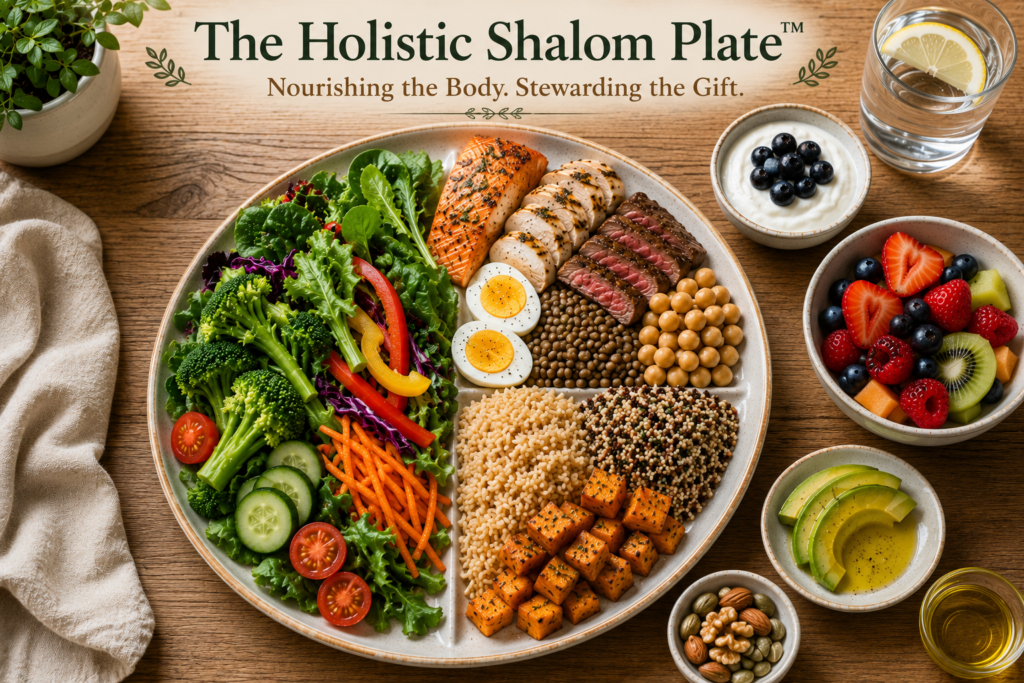
The Holistic Shalom Plate™ is a simple visual framework for building balanced meals that nourish the body through colorful vegetables, quality protein, wholesome carbohydrates, healthy fats, fruit, yogurt when appropriate, and water.
Nutrition Truths
Separating Fact from Fiction
❖ The Common Belief
🔍 COMMON BELIEF
"Carbohydrates make you fat."
It’s one of the most common nutrition messages in our culture…
When people begin thinking about nutrition, they often ask questions like:
- What should I eat?
- What should I avoid?
- How much protein do I need?
- Are carbohydrates good or bad?
- Which diet is best?
These are understandable questions, and they’re important ones.
Unfortunately, the answers people receive are often confusing. Every week there seems to be a new diet, a new headline, or a new expert claiming to have discovered the secret to healthy weight loss.
One message, however, has remained remarkably consistent:
“If you want to lose weight, cut the carbohydrates.”
Perhaps you’ve heard advice like:
- “Stop eating bread.”
- “Rice is bad for you.”
- “Potatoes are loaded with carbs.”
- “Avoid pasta if you want to lose weight.”
- “Fruit contains too much sugar.”
Maybe you’ve even followed a low-carbohydrate diet yourself.
Perhaps you watched the number on the scale fall during the first few weeks and concluded that carbohydrates must have been the problem all along.
If so, you’re not alone.
Millions of people have reached the same conclusion.
And at first glance, it seems perfectly reasonable.
If removing carbohydrates causes you to lose weight, doesn’t that prove carbohydrates were making you gain weight?
It’s an understandable conclusion.
But before we remove one of the body’s primary sources of nourishment, perhaps we should pause and ask a more important question.
What if we've misunderstood what carbohydrates actually do?
That simple question is the reason this article exists.
This article isn’t about persuading you to eat more carbohydrates. It’s about helping you understand how carbohydrates fit into a balanced pattern of eating that supports long-term health and faithful stewardship.
Nor is it to criticize every low-carbohydrate diet or dismiss the experiences of people who have found them helpful.
Our goal is much simpler.
Together, we’ll explore what the best available scientific evidence tells us about carbohydrates, how God designed our bodies to use them, and how they fit into a balanced pattern of eating that supports long-term health and sustainable weight management.
Along the way, we’ll separate common myths from scientific evidence, replace confusion with understanding, and discover that healthy nutrition is rarely about fearing a particular food. More often, it is about learning how different foods work together to nourish the body wisely.
Because lasting health is rarely built on fear.
It is built on understanding.
🌱 Wisdom for the Journey
Take a moment to reflect.
Fear often causes us to eliminate what we don’t understand. Wisdom invites us to seek the truth before deciding what belongs on our plate.
❖ The Big Idea
🌱 CORE PRINCIPLE
Carbohydrates are not the enemy of healthy weight loss. They are one of the body’s primary sources of nourishment and, when chosen wisely as part of a balanced diet, support lasting health, sustained energy, and healthy weight management.
If you remember only one sentence from this article, let it be this one.
For many years, carbohydrates have been viewed primarily through the lens of weight loss. They have been labeled as “good” or “bad,” praised by some diets and avoided by others.
But our bodies don’t think in terms of diet trends.
They think in terms of physiology.
Every cell in your body has been wonderfully designed to perform specific functions. Your brain requires a continuous supply of energy to think, learn, and concentrate. Your muscles need fuel to move, work, and exercise. Even while you sleep, your body is constantly repairing tissues, regulating hormones, supporting your immune system, and carrying out thousands of life-sustaining processes.
Carbohydrates are one of the primary ways God designed the body to meet those energy needs.
That doesn’t mean every carbohydrate is equally nourishing, nor does it mean we should eat unlimited amounts without wisdom or balance.
It simply means that carbohydrates themselves are not the enemy.
The real question is not whether we should eat carbohydrates.
The better question is:
“If you want to lose weight, cut the carbohydrates.”
How can we choose carbohydrates wisely as part of a balanced pattern of eating?
That is the question we’ll answer throughout the rest of this article.
Healthy eating is rarely about eliminating entire categories of food.
It is about understanding how different foods work together to nourish the body God has entrusted to our care.
🌱 Wisdom for the Journey
Take a moment to reflect.
Wisdom doesn’t ask, “What food should I fear?” Wisdom asks, “How can I faithfully nourish the body God has entrusted to me?”
❖ Understanding How God Designed Carbohydrates
🔬 SCIENTIFIC EVIDENCE
Before deciding whether carbohydrates belong on our plate, it helps to understand what they actually are and the remarkable role they play in the human body.
Carbohydrates are one of the three macronutrients that provide energy, alongside protein and fat.
When we eat carbohydrate-containing foods, our digestive system breaks them down into glucose, a simple sugar that enters the bloodstream and is delivered to cells throughout the body.
That glucose becomes fuel.
It powers your muscles as you walk, work, and exercise.
It supports your brain as you think, learn, solve problems, and make decisions.
It helps sustain countless biological processes that keep you alive every moment of every day.
Far from being unnecessary, carbohydrates are one of the primary ways the body meets its ongoing energy needs.
This doesn’t mean every carbohydrate is equally nutritious.
Nor does it mean that eating unlimited amounts promotes health.
It reminds us of an important truth.
The body was designed to use carbohydrates.
Understanding that design is the first step toward making wise nutritional choices.
🌱 Wisdom for the Journey
Take a moment to reflect.
When we understand how the body was designed to function, wise choices become less about following rules and more about living in harmony with God’s design.
❖ Why Low-Carbohydrate Diets Often Appear So Effective
🔬 SCIENTIFIC EVIDENCE
One of the strongest arguments against carbohydrates is surprisingly simple:
“I stopped eating carbohydrates, and I lost weight.”
For many people, that’s exactly what happened.
So how can carbohydrates not be the problem?
The answer begins with understanding what happens inside the body during the first few days of a low-carbohydrate diet.
Your Body Stores Carbohydrates
When you eat carbohydrates, your body doesn’t use every gram immediately.
Some are stored as glycogen, a form of stored carbohydrate found primarily in your muscles and liver. Glycogen serves as a readily available source of energy, allowing your body to respond quickly when you need fuel between meals or during physical activity.
An interesting characteristic of glycogen is that it is stored together with water. For every gram of glycogen stored, your body also stores several grams of water.
This is completely normal.
It’s part of the remarkable way God designed the human body to maintain a reserve of energy.
What Happens When Carbohydrates Are Greatly Reduced?
When someone begins a very low-carbohydrate diet, the body starts using those glycogen stores to meet its energy needs.
As glycogen is used, the water stored with it is released and eventually eliminated from the body.
As a result, the number on the scale often drops quite quickly during the first several days or weeks.
That early weight loss is real.
But much of it comes from depleted glycogen stores and the water that accompanies them, not from a sudden loss of body fat.
Understanding this helps explain why many people experience rapid initial success on low-carbohydrate diets.
Fat Loss Still Depends on Energy Balance
This doesn’t mean low-carbohydrate diets never help people lose body fat.
They certainly can.
Many people naturally eat fewer calories when they reduce highly processed foods, sugary drinks, sweets, and snack foods. Others find that meals containing more protein and fiber help them feel satisfied for longer, making it easier to maintain a calorie deficit.
In other words, people often lose body fat on a low-carbohydrate diet—not because carbohydrates are inherently fattening, but because the overall way they are eating has changed.
This is an important distinction.
The body loses fat when it consistently uses more energy than it receives from food over time. The foods we choose can make that process easier or harder, but no single nutrient alone determines whether body fat is gained or lost.
Looking Beyond the First Few Weeks
Many diets produce encouraging results at the beginning.
The greater challenge is maintaining those results over months and years.
Research consistently shows that the eating patterns people are most likely to sustain are generally balanced, enjoyable, and realistic for everyday life. Long-term success is influenced not only by the foods we choose but also by habits, physical activity, sleep, stress management, and consistency over time.
Healthy weight management is rarely the result of a temporary dietary strategy.
It is usually the result of building sustainable habits that can be practiced for life.
When we understand why early weight loss occurs and what truly drives long-term fat loss, we begin to see healthy eating differently.
The goal isn't simply to lose weight.
The goal is to build habits that help you flourish for a lifetime.
🌱 Wisdom for the Journey
Take a moment to reflect.
Quick results often capture our attention. Lasting habits transform our lives. Faithful stewardship isn’t measured by what we can sustain for a few weeks, but by the patterns we cultivate over a lifetime.
❖ Whole vs. Refined Carbohydrates
🔬 SCIENTIFIC EVIDENCE
By now, you may be wondering:
“If carbohydrates aren’t the problem, does that mean all carbohydrates are equally healthy?”
Not at all.
One of the most helpful distinctions we can make is the difference between whole carbohydrates and refined carbohydrates.
Although both provide energy, they affect the body quite differently because of how they are grown, processed, and prepared.
carbohydrate diet.
Whole Carbohydrates
Whole carbohydrates are foods that remain close to the way God created them.
They typically contain their naturally occurring fiber, vitamins, minerals, and beneficial plant compounds. Because they are digested more slowly, they often provide steadier energy, help people feel satisfied for longer, and support overall health.
Examples include:
- Oats
- Brown rice
- Quinoa
- Sweet potatoes
- Potatoes
- Beans
- Lentils
- Chickpeas
- Fruit
- Vegetables
These foods have nourished people for generations.
Rather than fearing them, we can learn how to include them wisely as part of a balanced dietary pattern.
Refined Carbohydrates
Refined carbohydrates have usually been processed to remove much of their natural fiber and some of their nutrients.
Common examples include:
- White bread
- Sugary breakfast cereals
- Cakes
- Cookies
- Pastries
- Candy
- Soft drinks
- Many snack foods
Because these foods are often lower in fiber and easier to digest, they may not keep us satisfied for as long. Many are also high in added sugars, refined grains, unhealthy fats, or calories while providing relatively little nutritional value.
The issue is not simply that these foods contain carbohydrates.
The issue is that they often replace more nourishing foods in our everyday eating pattern.
Looking at the Whole Plate
Healthy eating is rarely determined by a single food.
It is shaped by the overall pattern of our meals.
A bowl of oatmeal topped with berries and nuts provides a very different nutritional experience than a doughnut and a sugary coffee, even though both contain carbohydrates.
Likewise, a meal that includes vegetables, lean protein, wholesome carbohydrates, healthy fats, and water is very different from one built primarily around highly processed foods.
This is why Holistic Shalom emphasizes the whole plate rather than a single nutrient.
Nutrition works together.
The goal isn’t to fear one food.
The goal is to build meals that consistently nourish the body.
The Holistic Shalom Plate™ reminds us that lasting health is built by nourishing the whole body through balanced meals—not by fearing or celebrating a single nutrient.
Healthy eating isn't about choosing between carbohydrates and no carbohydrates.
It's about choosing carbohydrates wisely.
🌱 Wisdom for the Journey
Take a moment to reflect.
Wisdom doesn’t ask whether a food is simply “good” or “bad.” Wisdom learns to recognize what nourishes the body most consistently and chooses those foods more often with gratitude, balance, and joy.
❖ Building Balanced Meals That Nourish the Body
🌿 PRACTICAL WISDOM
Understanding carbohydrates is only the first step.
The greater challenge is learning how they fit within the bigger picture of healthy eating.
No single food provides everything the body needs.
God designed our bodies to thrive on a variety of nutrients working together. Protein supports the growth and repair of tissues. Healthy fats help produce hormones, protect organs, and aid the absorption of fat-soluble vitamins. Vegetables and fruit contribute vitamins, minerals, fiber, and countless plant compounds that support health. Wholesome carbohydrates provide a dependable source of energy that allows every system in the body to function well.
Each plays a different role.
Together, they create meals that nourish the whole person.
This is why Holistic Shalom emphasizes building balanced meals rather than counting or fearing individual nutrients.
The Holistic Shalom Plate™
The Holistic Shalom Plate™ is a simple visual framework that helps bring these principles together.
Instead of asking,
“Should I eat carbohydrates?”
the better question becomes,
“How can I build a meal that nourishes my body well?”
A balanced plate might include:
- Half the plate filled with colorful vegetables.
- One quarter with quality protein.
- One quarter with wholesome carbohydrates such as potatoes, brown rice, quinoa, oats, or legumes.
- Healthy fats included naturally through foods such as avocado, nuts, seeds, or olive oil.
- Water as the primary beverage.
- Fruit or yogurt when appropriate as part of an overall balanced eating pattern.
Rather than focusing on one nutrient, the plate reminds us to look at the meal as a whole.
That simple shift changes everything.
Balance Creates Freedom
When nutrition becomes a list of forbidden foods, eating often becomes stressful.
People swing between strict rules and guilty indulgence, rarely finding lasting peace.
Balanced eating offers a different path.
Instead of asking,
“”Did I break my diet today?”
we begin asking,
“Did today’s meals nourish the body God entrusted to me?”
That question encourages wisdom rather than perfection.
It allows room for celebrations, family meals, and the occasional dessert without abandoning a healthy pattern of eating.
Faithful stewardship is not measured by eating perfectly.
It is measured by consistently making wise choices over time.
Healthy nutrition isn't built meal by meal.
It's built choice by choice, day after day.
🌱 Wisdom for the Journey
Take a moment to reflect.
When we stop dividing foods into “allowed” and “forbidden,” we begin seeing every meal as an opportunity to care for the body God has entrusted to us. Lasting health grows through faithful, consistent choices—not fear, guilt, or perfection.
❖ Carbohydrates in Everyday Life
🌿 PRACTICAL APPLICATION
Understanding nutrition is valuable.
Living it consistently is where transformation happens.
Most people don’t struggle because they don’t know enough.
They struggle because everyday life is busy.
There are grocery stores to navigate.
Restaurants to enjoy.
Busy workdays.
Family dinners.
Vacations.
Birthdays.
Holidays.
No nutrition plan succeeds unless it fits into real life.
Fortunately, healthy eating was never designed to require perfection.
It was designed to become a pattern.
Progress, Not Perfection
One balanced meal will not transform your health.
Neither will one unhealthy meal destroy it.
Our bodies respond far more to the overall pattern of our choices than to any single day.
This is why consistency matters more than perfection.
Every meal is simply another opportunity to nourish the body God has entrusted to your care.
When one meal isn’t ideal, the next meal becomes another opportunity—not a reason to quit.
Practical Ways to Include Healthy Carbohydrates
Healthy carbohydrates can become part of almost every meal.
For example:
- Enjoy oatmeal with berries and nuts for breakfast.
- Choose brown rice, quinoa, or sweet potatoes alongside lean protein and vegetables.
- Snack on fruit instead of highly processed sweets when appropriate.
- Add beans or lentils to soups, salads, or grain bowls.
- Build meals around the Holistic Shalom Plate™ rather than around food rules.
These small decisions may seem ordinary.
Repeated day after day, they become powerful.
Flexibility Creates Sustainability
Healthy eating leaves room for life.
Family celebrations.
Holiday meals.
Birthday cake.
A favorite dessert shared with friends.
These moments do not erase months of faithful stewardship.
Instead of asking,
“Did I ruin everything?”
wisdom asks,
“What does my next wise choice look like?”
That single question often makes the difference between lasting change and giving up altogether.
Healthy Eating Is a Lifestyle
Healthy nutrition isn’t something we practice for twelve weeks.
It becomes part of how we live.
It shapes how we shop.
How we cook.
How we celebrate.
How we care for our families.
And ultimately, how we steward the remarkable body God has given us.
Healthy eating isn't about being perfect.
It's about making your next wise choice.
🌱 Wisdom for the Journey
Take a moment to reflect.
Faithful stewardship isn’t measured by flawless days. It is built through thousands of ordinary choices made with wisdom, gratitude, and perseverance. Every meal is another opportunity to care well for the life God has entrusted to you.
❖ Conclusion: Returning to the Table with Wisdom
🌿 FINAL REFLECTION
When you first opened this article, you may have been asking,
“Are carbohydrates good or bad?”
Perhaps you’ve spent years trying to avoid them.
Perhaps you’ve felt guilty every time you enjoyed bread, potatoes, rice, or fruit.
Perhaps you’ve wondered why nutrition advice always seems to change.
My hope is that you’ve discovered a better question.
Not,
“How do I eliminate carbohydrates?”
But,
“How can I wisely nourish the body God has entrusted to my care?”
That question changes everything.
Healthy eating is no longer built around fear.
It is built around wisdom.
It is no longer about searching for the perfect diet.
It is about learning to faithfully steward your body over a lifetime.
Carbohydrates were never intended to be the enemy.
Like every good gift, they are meant to be received with wisdom, gratitude, and balance.
When we understand how God designed our bodies, nutrition becomes less confusing.
Instead of constantly chasing the newest trend, we can return to simple, enduring principles.
Eat real food.
Build balanced meals.
Enjoy food with gratitude.
Care for your body consistently.
Trust that small, faithful choices made over many years produce far greater fruit than short bursts of perfection.
That is the path toward lasting health.
That is the path toward flourishing.
That is the path toward Holistic Shalom.
Final Invitation
The next time you sit down to eat…
Pause.
Look at your plate.
Rather than asking,
“Should I eat these carbohydrates?”
Ask,
“Does this meal help nourish the body God has entrusted to me?”
One question produces fear.
The other produces wisdom.
And wisdom is the better guide.
Healthy eating isn't about fearing food.
It's about faithfully stewarding the gift of your body—one wise choice at a time.
🌱 Wisdom for the Journey
Take a moment to reflect.
Every meal is an opportunity to practice gratitude, wisdom, and faithful stewardship. You don’t need to eat perfectly to flourish. Simply make your next meal your next wise choice, trusting that God often grows lasting fruit through small acts of everyday faithfulness.
🚶 Continue the Journey
You’ve learned why carbohydrates matter. Now discover why lasting weight loss has much less to do with dieting than most people think.
The Truth About Weight Loss
Why lasting weight loss has less to do with finding the perfect diet and more to do with understanding how the body was designed to flourish.
